CTO & Head of AI, Tickr Senior AI Advisor, Subpoena Solutions Research Fellow, UC Santa Cruz
I lead AI strategy and execution and act as the technical and AI face for several organizations, while staying hands-on across product AI, agentic systems, and LLM post-training. I mentor the AI scientists and engineers I work with and still build alongside them.
Today I lead the research and technical direction of RiskWise at Tickr, a platform that helps insurers and Big Four firms see which risks are turning into litigation and regulatory action before they do. I joined in 2016 as its first AI hire; the team is now close to twenty, and product and engineering report to me alongside AI. The role runs the full range: I set the product and model strategy, sit across the table from enterprise buyers, defend the technology to their risk and procurement teams, and own the evaluation and governance regulated customers require, all while still building at the center of it.
I've also spent seven years as a fractional AI lead for legal-tech startups, two of them since acquired, building early systems that read legal demands and draft grounded objections. That work is as much legal strategy as engineering: defensibility, privacy-preserving pipelines, attorney-in-the-loop review, and keeping a product differentiated as general models absorb more of the task, which are the things legal buyers weigh before they trust a model. The same problems have shown up across finance, insurance, healthcare, and science.
I set research strategy and hand real ownership to the scientists doing the work; several of the results below are theirs, not mine. I still hire, stay in the code, and most weeks I'm in front of enterprise clients. I also use more tokens than anyone else at the company, which is either commitment or a budgeting problem, depending on who you ask.
I came to agents through data science, deep learning, and scientific research, and I still do all three. At NASA Ames I used recurrent networks to forecast load on a microgrid. As a Research Fellow at UC Santa Cruz I built NEO, which uses a conditional generative model to sharpen telescope images, and I've been building an agent that proposes scientific hypotheses, runs experiments, and tries to disprove its own results.
Away from AI, I'm a competitive sailor. At 14 I led a team that won an open world championship and became the youngest sailor to do so, with second places at the Etchells and Mumm 30 world championships and a third at the International 14 Worlds in the years since. I was the youngest person ever to be first to finish the Transpacific Yacht Race, and I've skippered a boat at the Olympic trials. Sailing taught me what it takes to be world-class at a craft, and it taught me leadership early.
I built and run the roughly twenty-person organization behind RiskWise: applied AI scientists, ML engineers, data scientists, software engineers, and product. I started as Tickr's first AI hire, grew the function from a team of one, hired most of it, and set its structure. As AI became the center of the product, engineering and product were folded under me alongside it, and I now own the technical direction across all three.
The job is mostly judgment and people. Ten or more initiatives run at once, and I decide which ones get the compute and the headcount. I set research strategy, hire, develop and promote from within, and keep the team close to customers so they understand what a failure actually costs. I carried the group through a full pivot to AI-first products with the team intact, and kept it shipping the whole way.
Outside the org chart I'm the technical face to enterprise buyers, from the Fortune 10 to the Fortune 500, and I negotiate the partnerships the platform runs on: data providers, labeling vendors, and model platforms including Anthropic and OpenAI. I've also acted as fractional AI lead for three startups, two of which were acquired.
I stay close enough to the technical work to lead it credibly, still hiring, reviewing architecture, and getting into the code. Most of my impact, though, is in setting direction and then handing over real ownership. The thirty-task deep-research evaluation, for instance, was a direction I set and a scientist on the team carried end to end, which is how I want it to work.
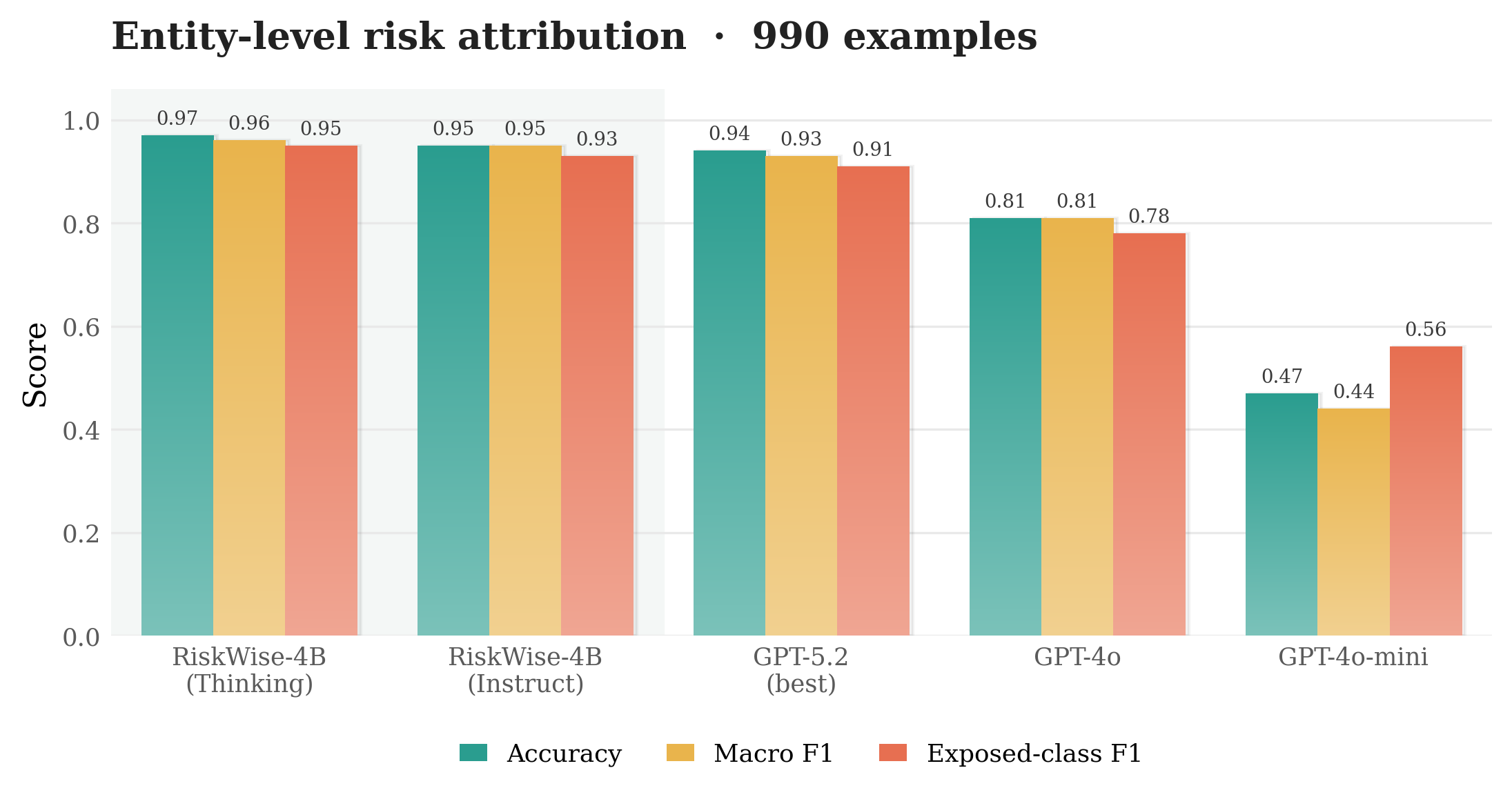
Most of my hands-on work is on agent systems and post-training. I post-trained a 4B risk-attribution model that cut errors roughly 50% against GPT-5.2 at nearly 20× lower inference cost, and fine-tuned Qwen 3 with QLoRA/PEFT on eight H100s alongside bge-large-en-v1.5 for retrieval, reaching 98.1% F1 across four hierarchical datasets against 86.1% for GPT-4o and 86.6% for Claude 3.5 under identical conditions. I've built agentic discovery using a Thompson-sampling bandit over natural-language research briefs run as frontier-model search episodes, with reward computed in code rather than by the model, and an MCTS-guided research system that attacks its own findings before recording them. On evaluation I've stood up adversarial LLM-as-judge, capability, regression, and human-gold suites for actuarial, legal, and compliance review. New production failures start as capability tests and, once reliable, become regression tests, so a later model, instruction, or system change cannot quietly undo them. I set the strategy for a 30-task evaluation of high-stakes risk deep research and mentored the scientist who ran it; against open-web retrieval it improved source traceability by 10.4 points and analytical rigor by 3.3. agent infrastructure · RAG tuning · evaluation
I lead RiskWise, an agentic risk-intelligence platform licensed by major insurers and Big Four firms. It continuously monitors a catalog of tracked companies, risk topics, and industries, ingesting from more than 50 licensed and public sources: LexisNexis, CourtListener and RECAP, JPML dockets, SEC EDGAR, DOJ enforcement actions, FDA recalls and FAERS, PubMed, news, X, and Reddit. The work is framed around legal and property-and-casualty exposure, including product liability, D&O, transport, antitrust, cyber, and employment practices, and looks for the correlation risk, tail risk, and emerging threats that conventional taxonomies miss.
Turning that volume into signal is most of the engineering. A processing pipeline disambiguates entities, filters spam, reranks passages for relevance with a fine-tuned embedding model, and decomposes each risk into drivers whose movement is tracked as an index over time. On top of it run analyst agents grounded in that evidence: a deep-research agent that writes underwriting-grade reports with citations back to source, company- and driver-level narrative summaries, and a risk search agent. Each one cites the evidence it drew on so an underwriter can trace a conclusion back to the filing or article behind it. The output feeds underwriting, portfolio diversification, and board risk.
One of the predictive layers forecasts litigation. A multi-armed bandit over research agents feeds a discrete-time hazard model of multidistrict-litigation consolidation at 0.90 held-out AUC; backtested point-in-time on data frozen at January 2022, 2023, and 2024, between 16 and 32% of its top 25 ranked risks later became MDLs against a base rate under 1%, surfacing them 8 to 24 months early. benchmarks against frontier models
Seven of my thirteen years in AI have been in legal. At Subpoena Solutions I built the proof-of-concept of an intake system that reads subpoenas, search warrants, Section 2703(d) orders, preservation demands, and emergency requests, classifies the demand, and drafts grounded objections. Six LLM classifiers are grounded in 50-state law. I used DSPy and MIPROv2 to improve them, then added an embedding-based normalization layer so an incorrect generation could not break the downstream workflow. I've fine-tuned models on attorney-reviewed legal process data and built evaluation with confidence-gated attorney review, cutting errors more than 50% against frontier baselines on 20+ tasks. For privacy-sensitive clients whose policies prohibit fine-tuning, I've mentored engineers building self-improving agentic loops that optimize instructions rather than weights. Two of the three legal-tech startups I've advised have been acquired.
The role has been as much leadership as engineering. At Subpoena Solutions my work led to a private-equity acquisition and to standing up a dedicated AI and engineering team; I run weekly mentorship for that team and advise its leadership on staying differentiated as general models absorb more of the work. At SpeedLegal I worked with the CEO on that same question and defended the technology to investors during a contested fundraise. At Joinder, since acquired by Brightflag, I built the signature-detection and legal-taxonomy models the product shipped on. Across RiskWise I'm the lead architect for the legal-risk features and set the direction the team builds against.
A decade of demand forecasting and causal inference on CPG and retail data. I've built SARIMAX and Prophet pipelines with exogenous regressors, holiday calendars, and Bayesian MCMC fits, benchmarked univariate against multivariate specifications with automated hyperparameter search, and run these at retailer and product-group granularity for national brands. I built Generative Predictor Search over millions of economic series using retrieval, reciprocal rank fusion, and LLM reranking, which cut out-of-sample MAPE 15.6% and ran 13× faster than exhaustive search. I hold a US patent application on causal inference for marketing campaign impact, and trained DeBERTa-XXL across 500+ product classes with a triplet-loss embedding model that anchored a multi-million-dollar contract. My work has crossed financial services, insurance, healthcare, legal, and science: for FIS I worked on dynamic product categorization and applied early reasoning LLMs to Medicare Advantage benefit classification. GPS · causal impact
I hold a research fellowship at UC Santa Cruz alongside the CTO role. I'm first author on NEO, a conditional GAN that improves the accuracy of physical measurements by factors of 2 to 10, with code and weights released publicly and coverage in the NVIDIA blog. I'm a co-author on a Nature Portfolio paper, and I built an autonomous discovery system that ran 49 analyses across 25 years of satellite data and reported one of its three hypotheses as inconclusive rather than forcing a conclusion.
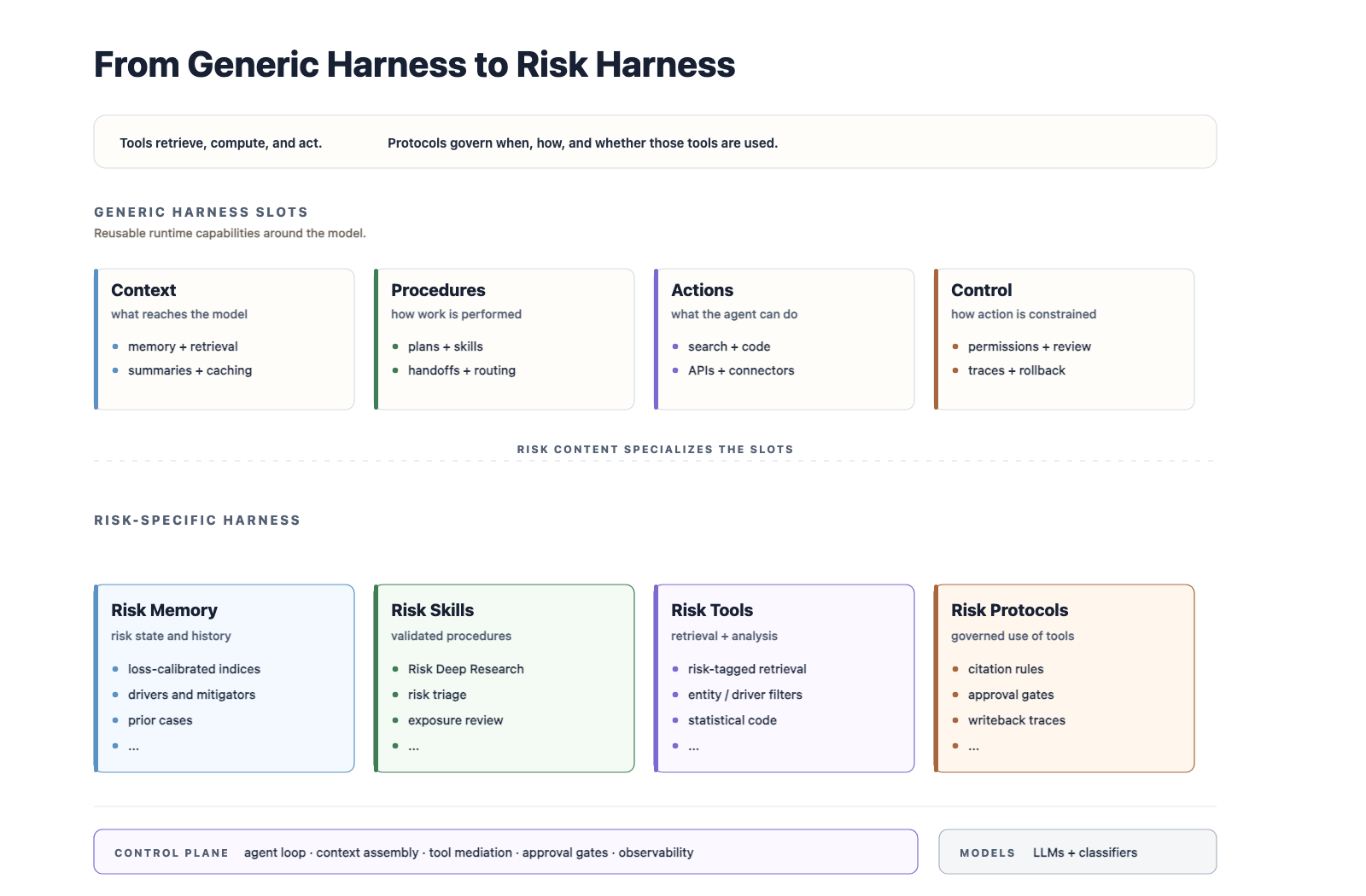
The memory, procedures, permissions, and decision traces an agent needs before you can put a real decision through it.
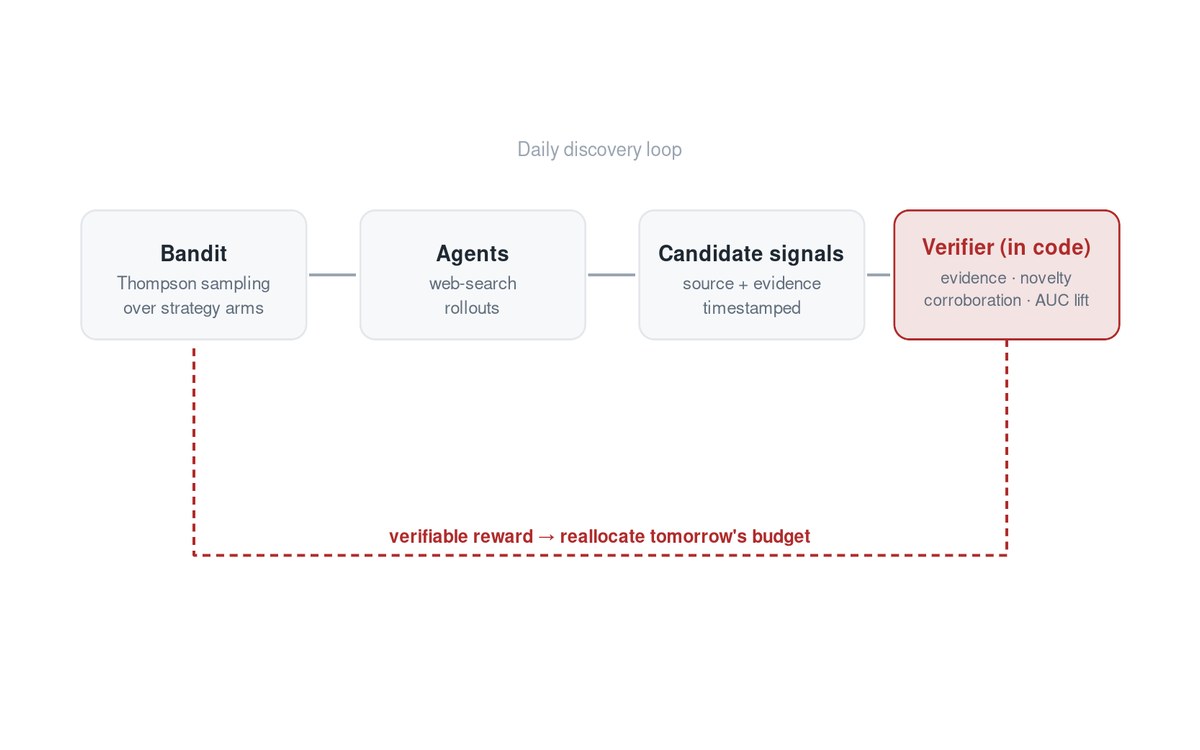
A Thompson-sampling bandit allocates research agents under a reward computed in code, feeding a discrete-time hazard model. 0.90 held-out AUC.
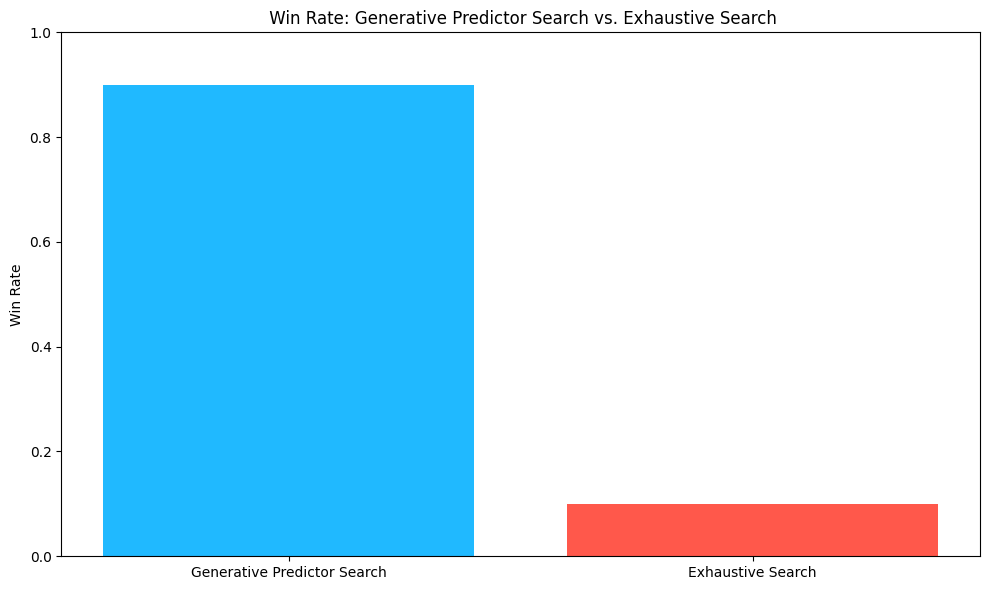
LLM reasoning proposes and validates covariates for time-series forecasting, cutting MAPE 15.6% and running 13× faster than exhaustive search.
A conditional GAN that recovers measurement structure ground-based seeing destroys, improving accuracy by factors of 2 to 10. Featured by NVIDIA.
98.1% F1 on dynamic hierarchical categorization, ahead of GPT-4o and Claude 3.5 under identical conditions.
19 cycles and 49 analyses on 25 years of satellite data, with every finding put through an adversarial gate before it was kept.