Whispers of Latent Reasoning: How RiskWise Achieves More Accurate Risk Attribution
Most risk intelligence systems fail the same way: they confuse what is being discussed with what is actually at risk. In an environment saturated with speculation, warnings, and early concern, detecting risky topics is easy. Determining whether a specific entity is meaningfully exposed is not.
At RiskWise, we approach this problem as a reasoning task, not merely a sentiment or topic-detection problem. We train small, specialized language models (under 10B parameters) to scale reasoning and support agentic decision-making for detecting, measuring, and predicting risk with a focus on epistemic precision.
A core application of this approach is entity-level perceived-risk attribution: determining whether a specific company, organization, or individual is perceived to be exposed to a given risk based solely on contextual evidence. This task sits at the foundation of RiskWise's ability to separate weak signals from noise and convert unstructured language into measurable, decision-ready risk indicators (see Seeing Risk Clearly).
On this entity-level risk perception task, our 4B thinking-tuned model consistently outperforms an equivalently sized instruction-tuned 4B model, even when we explicitly suppress chain-of-thought. The improvement does not come from longer explanations or visible reasoning traces, but from stronger internal reasoning representations shaped during training.
This finding is consistent with prior research showing that chain-of-thought training improves internal reasoning capabilities rather than merely increasing generation length, and suggests that latent reasoning capability can persist even when reasoning traces are not exposed (Wei et al., 2022; Kojima et al., 2022; Chen et al., 2024).
For RiskWise, this distinction is central. Measuring risk requires separating true exposure from sentiment and narrative noise. Entity-level perceived risk is not about how loudly a topic is discussed, but whether contextual evidence actually links an entity to potential vulnerability. Models with stronger latent reasoning are better equipped to make this separation, recognizing when language reflects precaution, speculation, or reputational concern versus when it signals genuine exposure. By embedding reasoning into the model itself rather than emitting it as text, RiskWise can perform this distinction reliably and at scale, enabling more precise risk indices and earlier detection of emerging threats.
Risk is about epistemic status, not topic detection
In operational settings, effective risk measurement requires distinguishing between two fundamentally different signals: perceived risk, credible signals that an entity is believed to be exposed (warnings, allegations, forecasts, speculation, reputational concern); and actual risk, exposure that has been verified through confirmed findings, measurements, or official determinations. This distinction closely aligns with classical definitions of perceived risk in decision science, which emphasize uncertainty combined with potential adverse outcomes rather than confirmed harm (Bauer, 1960; Slovic, 1987).
News and research text are saturated with epistemic language such as may, could, experts warn, under investigation, and more research is needed. Systems that treat negative sentiment or narrative tone as a proxy for risk, a common approach in media-intelligence and reputation-monitoring platforms, tend to over-predict exposure when uncertainty or speculation is present (see Seeing Risk Clearly).
RiskWise is explicitly designed to avoid this failure mode. Rather than inferring risk from tone alone, our models evaluate epistemic status directly, determining whether a passage asserts, speculates about, or confirms exposure for a specific entity. This lets us separate concern from sentiment, and uncertainty from evidence, with the precision required for real-world decision-making.
Grounded, entity-specific risk attribution
Each evaluation example consists of three inputs and one constrained output. The inputs are
an entity (the specific object for which risk exposure is being evaluated,
e.g. GLP-1); a risk driver and description (a predefined risk
category specifying what type of harm or exposure is being assessed, e.g. health harms from
ultra-processed foods, with a description covering chronic disease, inflammation, hormonal
disruption, and additive risks); and a context passage, a short excerpt from
a news article, tweet, or regulatory filing that may or may not indicate risk exposure for
the given entity. For example:
"Experts warn that ultra-processed foods engineered to maximize fat, sugar, and salt intake are contributing to rising obesity rates. While these products are increasingly scrutinized, researchers note that more evidence is needed to understand long-term health impacts. GLP-1 drugs are being studied for their role in regulating appetite and metabolism."
The model must determine whether perceived risk is present for the specified entity based
solely on the provided context, and return JSON only, e.g.
{"entity":"GLP-1","label":0}. A label of 1 indicates a credible
signal that the entity is believed to be exposed to the risk driver; 0 indicates
that no such signal is present in the text.
RiskWise models outperform on entity-level risk attribution
We evaluate all models on the same entity-level perceived-risk classification benchmark,
consisting of 990 examples (648 negative, 342 positive). Each model is tested under identical
conditions: the same prompts, entity and risk-driver definitions, the same context passages,
and JSON-only outputs. Evaluation conditions are held constant across models: deterministic
decoding at temperature 0, identical post-processing and scoring, and strict structured
output constraints where a failure to parse defaults to no exposure. For thinking-capable
models we evaluate two modes: No Thinking, explicitly suppressing chain-of-thought
output while preserving the model's reasoning mode via meta tags such as
<think> tokens; and Thinking, a constrained reasoning prompt that
allows limited sequential reasoning before the final JSON output.
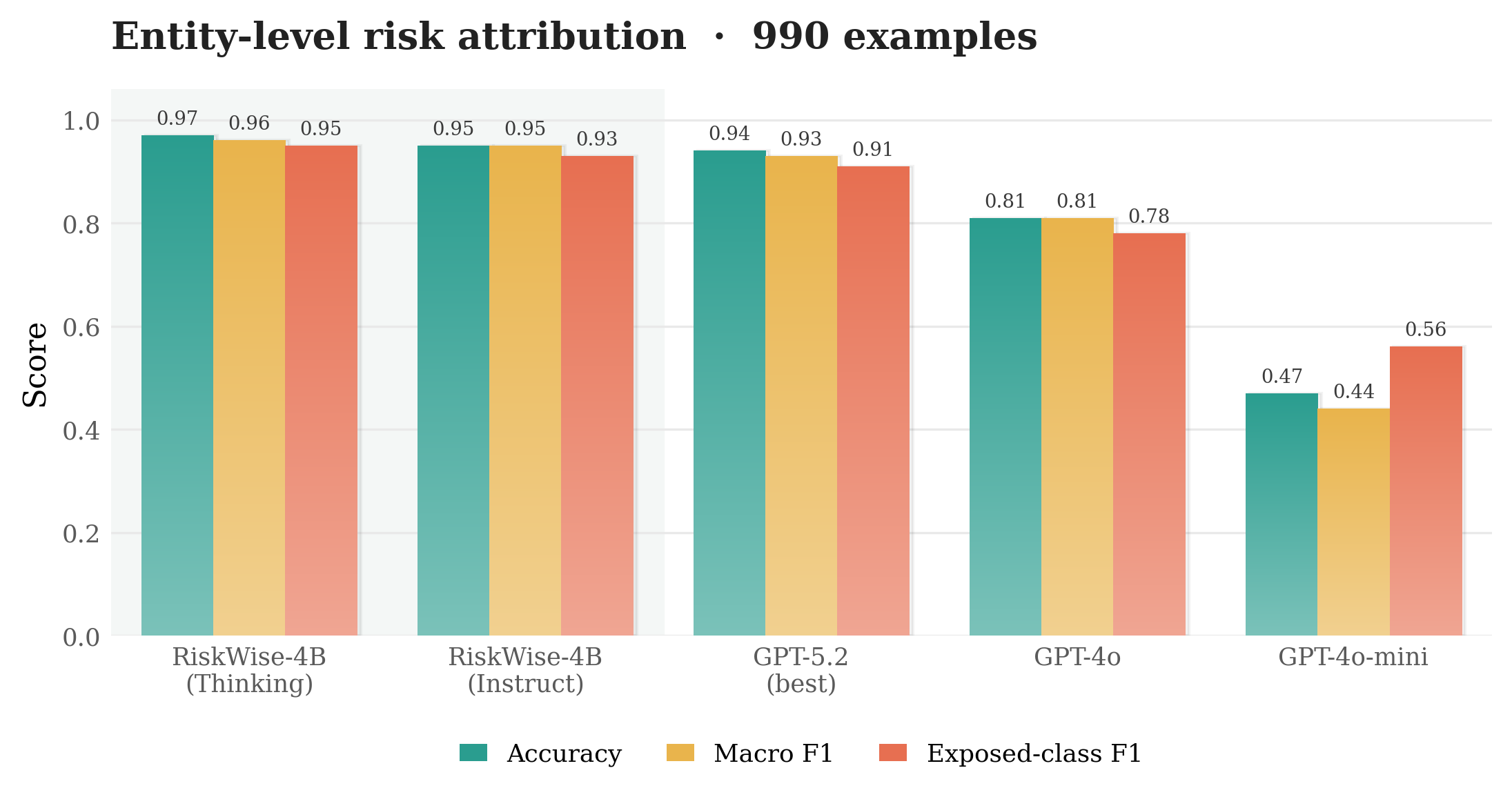
| Model | CoT setting | Accuracy | Macro F1 | Exposed Class F1 |
|---|---|---|---|---|
| RiskWise-4B-Thinking | No Thinking | 0.97 | 0.96 | 0.95 |
| RiskWise-4B-Thinking | Thinking | 0.96 | 0.96 | 0.95 |
| RiskWise-4B-Instruct | No Thinking | 0.95 | 0.95 | 0.93 |
| GPT-5.2 | Medium Thinking | 0.94 | 0.93 | 0.91 |
| GPT-5.2 | High Thinking | 0.93 | 0.93 | 0.91 |
| GPT-5.2 | Low Thinking | 0.92 | 0.92 | 0.91 |
| GPT-5.2 | No Thinking | 0.90 | 0.89 | 0.87 |
| Qwen-4B-Thinking | No Thinking | 0.85 | 0.83 | 0.76 |
| GPT-4o | No Thinking | 0.81 | 0.81 | 0.78 |
| Qwen-4B-Thinking | Thinking | 0.66 | 0.43 | 0.06 |
| Qwen-4B-Instruct-2507 | No Thinking | 0.63 | 0.63 | 0.65 |
| GPT-4o-mini | No Thinking | 0.47 | 0.44 | 0.56 |
The results:
- RiskWise-4B-Thinking outperforms RiskWise-4B-Instruct across all reported metrics, including accuracy, macro F1, and Class-1 F1.
- Performance gains persist when chain-of-thought is explicitly suppressed, indicating that the improvements are not driven by emitted reasoning text.
- Allowing chain-of-thought recovers most of the gains of a thinking model with chain-of-thought suppressed, suggesting diminishing returns from additional reasoning verbosity.
- Improvements are concentrated on the minority and operationally highest-cost class.
- Accuracy improves from 0.95 to 0.97, roughly a 40% relative reduction in error rate.
- Compared to frontier models, RiskWise-4B-Thinking (both thinking and no-thinking modes) and RiskWise-4B-Instruct exceed GPT-5.2 across all metrics, and match or outperform GPT-5.2 even with high reasoning enabled, evidence that targeted internal reasoning training can outperform scale-plus-reasoning approaches.
- General-purpose instruction models such as GPT-4o and GPT-4o-mini underperform substantially (0.81 and 0.47 accuracy), reinforcing that entity-level perceived-risk attribution requires domain-aligned reasoning rather than generic instruction tuning.
Why "thinking" helps, even when you hide the thinking
This result follows directly from how the models were trained, without requiring speculation about internal mechanisms.
Chain-of-thought is a training signal before it is an output style. Chain-of-thought prompting has been shown to significantly improve performance on multi-step reasoning tasks by encouraging decomposition and intermediate state tracking (Wei et al., 2022), and follow-up work demonstrated that even minimal reasoning cues can activate these benefits (Kojima et al., 2022). Critically, that line of research does not claim the textual output of the chain-of-thought is the source of the improvement. Rather, models trained or prompted to reason step-by-step develop stronger internal representations that generalize beyond the presence of visible reasoning traces. Our findings extend this insight to operational risk attribution: models retain these gains even when chain-of-thought is suppressed at inference time.
Internal reasoning can persist without verbalization. Recent work has explicitly examined latent or silent reasoning, where intermediate computation occurs without being emitted as natural-language text (Chen et al., 2024; Jiang et al., 2024). Related approaches, such as token-wise reasoning, reinforce the distinction between internal computation and emitted explanation by showing that structured reasoning can be distributed across token representations rather than serialized as explicit chains of thought. Consistent with these findings, we observe that a thinking-tuned model outperforms an equivalently sized instruction-tuned model even when chain-of-thought output is explicitly suppressed. This does not prove a specific internal mechanism, but it is empirical evidence that the benefits of reasoning-focused training can persist independently of visible reasoning traces.
Perceived-risk attribution rewards epistemic bookkeeping. Perceived-risk classification requires the model to internally track a structured set of epistemic states: who is making a claim, what is asserted versus speculated, whether the assertion attaches to the entity, and whether it is supported by verification or evidence. These are not surface-level pattern matches. They are intermediate checks that chain-of-thought training reinforces, even when those checks are never emitted as text.
Additional benefits of "thinking without thinking"
There are both practical and scientific reasons to suppress emitted reasoning text in production-grade risk systems. On faithfulness, emitted chain-of-thought explanations are not guaranteed to faithfully reflect a model's internal computation; in many cases they function as post-hoc rationalizations rather than true explanations of the decision process (Barez et al., 2023), so treating them as ground truth can introduce false confidence rather than transparency. On latency and cost, generating reasoning text materially increases token usage and inference latency without improving downstream utility in structured decision pipelines; in practice, models can over-reason, producing verbose intermediate text that far exceeds the token budget required for the final decision. On automation and reliability, operational risk systems require deterministic, machine-parseable outputs, and free-form reasoning text introduces unnecessary variability that can make parsing errors more likely.
Takeaways
Risk attribution is fundamentally an epistemic reasoning problem, not a topic-matching task. It requires models to interpret uncertainty, attribution, and scope, distinguishing speculation from assertion and concern from exposure, rather than simply detecting the presence of risky language.
Our results show that reasoning-oriented training can meaningfully improve performance even when reasoning is not explicitly exposed, indicating that the benefits of such training are not tied to output verbosity. In this setting, small, specialized open models can match or outperform larger frontier systems on narrow, high-precision tasks when trained with the appropriate inductive biases. "Thinking without thinking" is therefore not a paradox: it reflects latent reasoning capacity shaped by supervision, embedded within the model itself rather than expressed through emitted chains of thought.
RiskWise offers high-confidence risk attribution at scale by reaching state-of-the-art entity-level accuracy in a 4B-parameter model, which lets it run at a fraction of the cost and latency of frontier systems. Lower marginal cost combined with higher precision yields cleaner, more stable risk statistics across large volumes of heterogeneous data, improving both risk measurement and the quality of downstream decisions.
Citations
Bauer, R. A. (1960). Consumer behavior as risk taking.
Slovic, P. (1987). Perception of risk. Science.
Wei, J. et al. (2022). Chain-of-Thought Prompting Elicits Reasoning in Large Language
Models.
Kojima, T. et al. (2022). Large Language Models Are Zero-Shot Reasoners.
Chen, X. et al. (2024). Reasoning Beyond Language: Latent Chain-of-Thought
Reasoning.
Jiang, A. et al. (2024). DART: Distilling Autoregressive Reasoning to Silent
Thought.
Barez, F. et al. (2023). Chain-of-Thought Is Not Explainability.