Code Release
The NEO source code and trained models are publicly available for immediate use by the astronomical community. The code includes the full model architecture, training pipeline, and inference tools for applying NEO to new data.
Samuel Kahn1, Ryan Hausen2, Hubert Bretonnière1,*, Nicole E. Drakos3, and Brant E. Robertson1
1Department of Astronomy and Astrophysics, University of California, Santa Cruz, 1156 High Street, Santa Cruz, CA 95064 USA
2Department of Physics and Astronomy, The Johns Hopkins University, 3400 N. Charles St., Baltimore, MD 21218, USA
3Department of Physics and Astronomy, University of Hawaii, Hilo, 200 W Kawili St, Hilo, HI 96720, USA
*Current address: Vall d'Hebron Institute of Oncology (VHIO), Barcelona, Spain
The measurement of galaxy morphological parameters from astronomical images features in a wide range of modern analyses, including cosmological weak lensing and galaxy evolution studies. The precision and accuracy of morphological parameter estimation can be influenced by several key factors: the effective seeing (PSF), the pixel scale, and the depth of observations. Here, we develop a conditional generative adversarial network, called NEO, trained to transform existing ground-based images into sharper, finer-scale images comparable to space-based image quality. We demonstrate that NEO improves the accuracy of measured morphological parameters by factors of 2–10 when trained to translate Subaru Hyper Suprime-Camera (HSC) images to approximate Hubble Space Telescope (HST) data. NEO is designed for applicability to ongoing, large-scale surveys such as the Legacy Survey of Space and Time (LSST) conducted by Vera C. Rubin Observatory in combination with spaced telescopes such as HST, James Webb Space Telescope, and Nancy Grace Roman Space Telescope.
The NEO source code and trained models are publicly available for immediate use by the astronomical community. The code includes the full model architecture, training pipeline, and inference tools for applying NEO to new data.
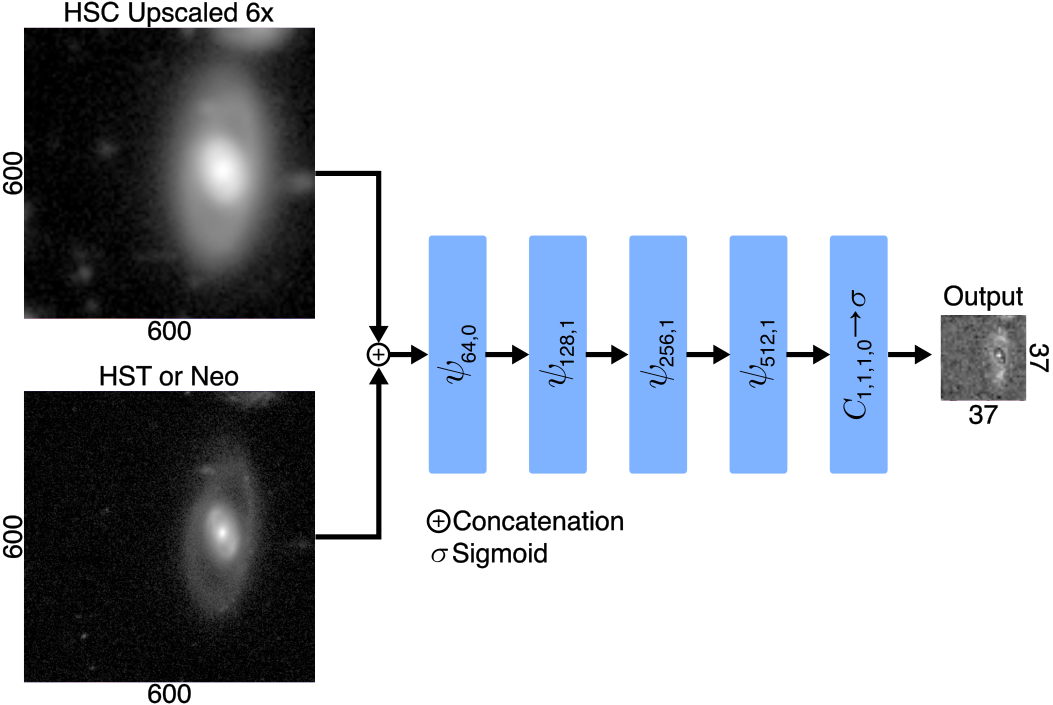
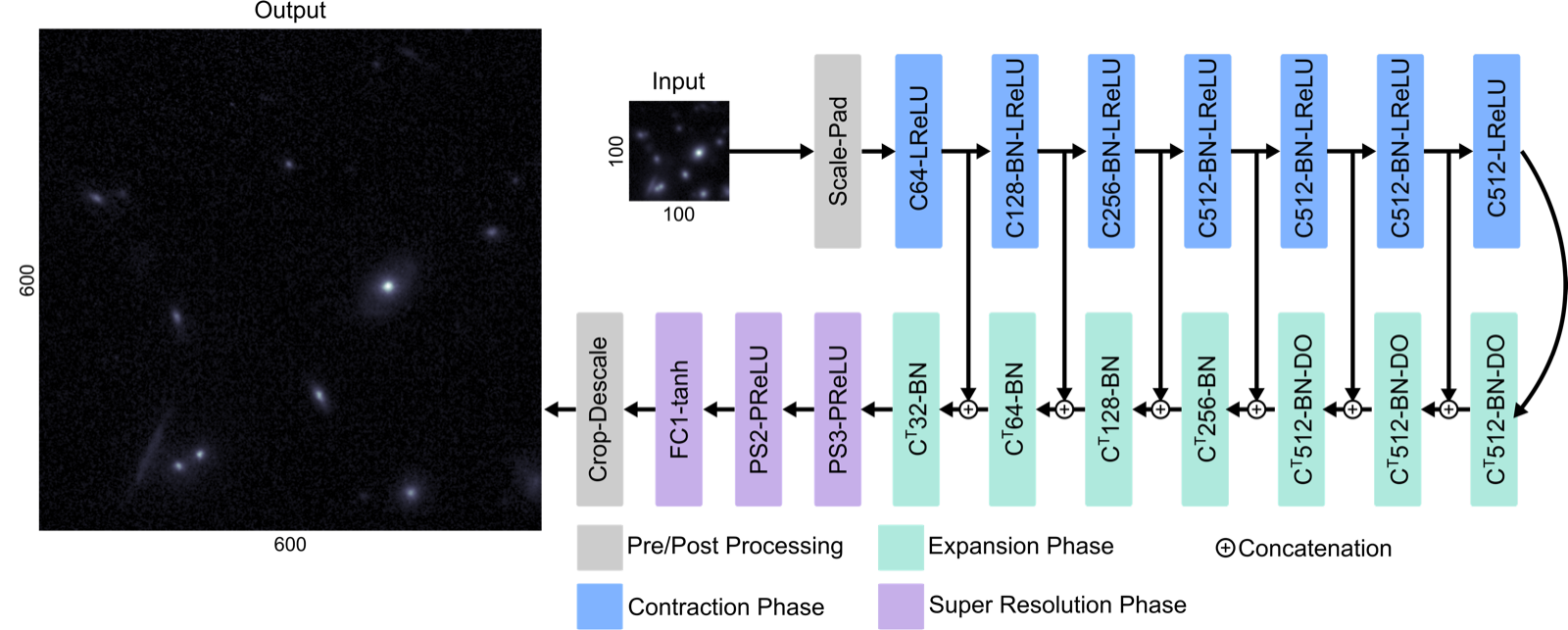
NEO is inspired by the U-Net and Super-Resolution GAN (SRGAN) architectures. The generator follows a U-Net structure with contraction, expansion, and super-resolution phases, translating 100×100 pixel HSC cutouts into 600×600 pixel super-resolution images. The PatchGAN discriminator classifies patches of input as real or synthetic, enabling the model to produce realistic local image textures.
NEO is trained on paired observations from the HSC telescope (ground-based, i-band, 0.168 arcsec/pixel, PSF FWHM ~1.3 arcsec) and HST (space-based, F814W, 0.03 arcsec/pixel, PSF FWHM ~0.09 arcsec) in the COSMOS field. The training set uses ~1.5 million cutouts from the overlapping region, with 20% reserved for validation.
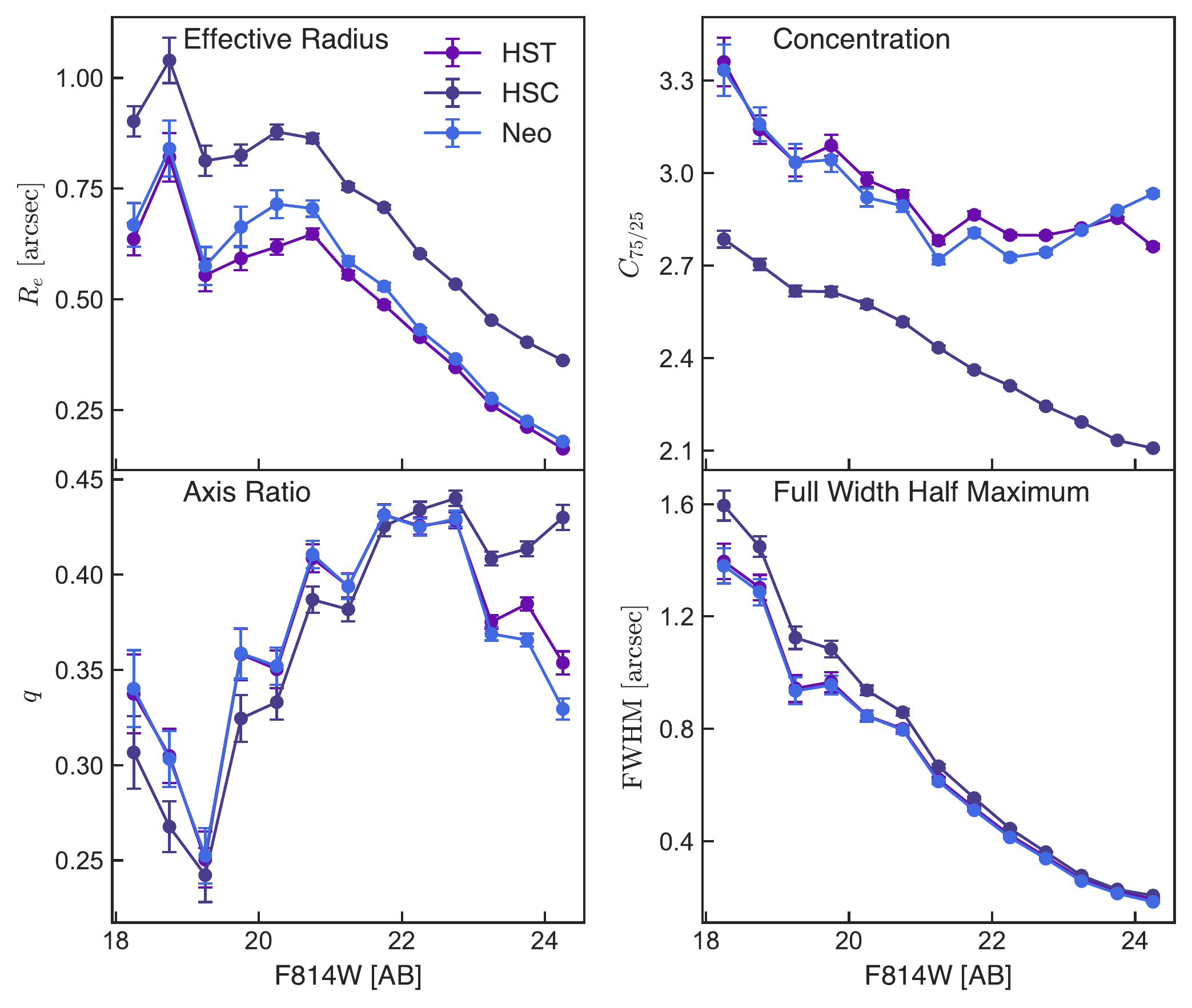
NEO significantly reduces biases in morphological parameter measurements relative to ground-based HSC data, recovering values closely matching those measured from high-resolution HST data.
Mean relative bias of 0.04 ± 0.30 from NEO images, compared to 0.72 ± 0.18 from HSC. A factor of ~18× improvement in accuracy.
NEO achieves a FWHM bias of −0.02 ± 0.06, a dramatic improvement over the HSC bias of 0.82 ± 0.05. NEO images recover FWHM values nearly identical to HST.
NEO yields a mean absolute bias of 0.03 ± 0.04, comparable to its single-image performance and substantially better than the HSC bias of 0.11 ± 0.14.
The mean relative bias from NEO images is 8.7×10⁻³ ± 0.11, while the HSC bias is −0.20 ± 0.11. NEO recovers galaxy concentrations accurately across all magnitudes.
NEO achieves an orientation similarity measure of 5.6×10⁻⁴ ± 0.10, recovering galaxy orientations across the full magnitude range with negligible scatter.
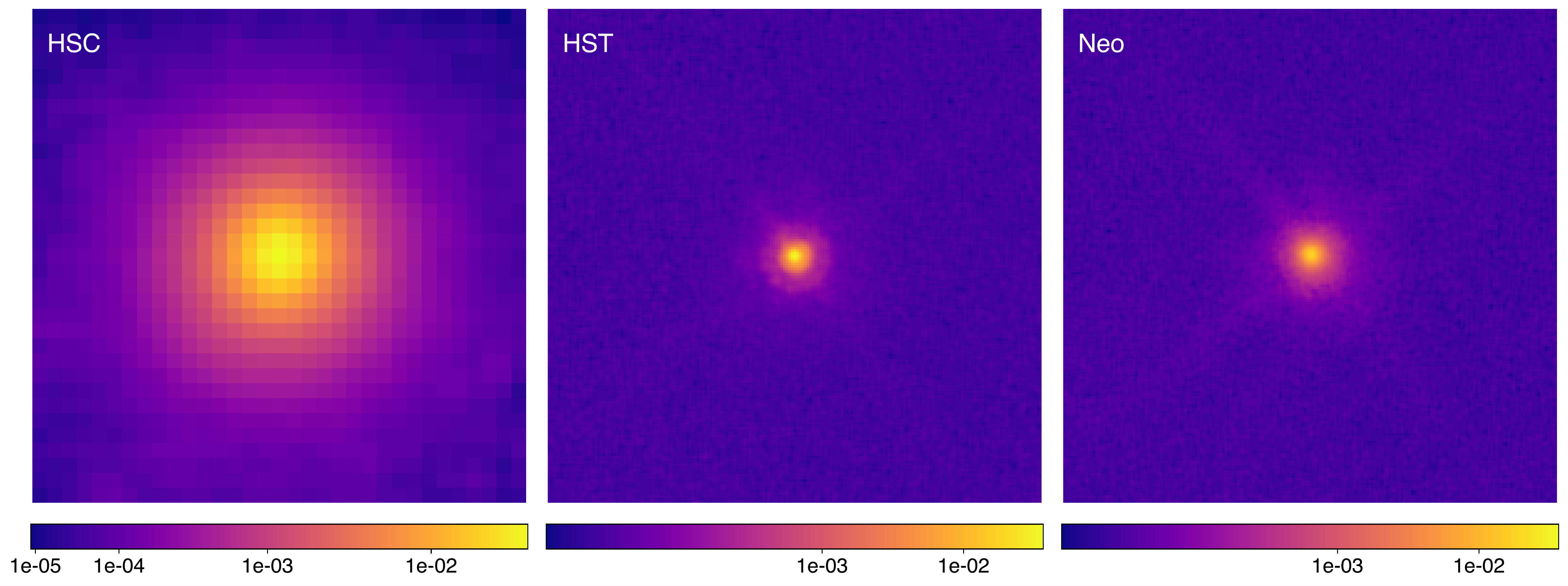
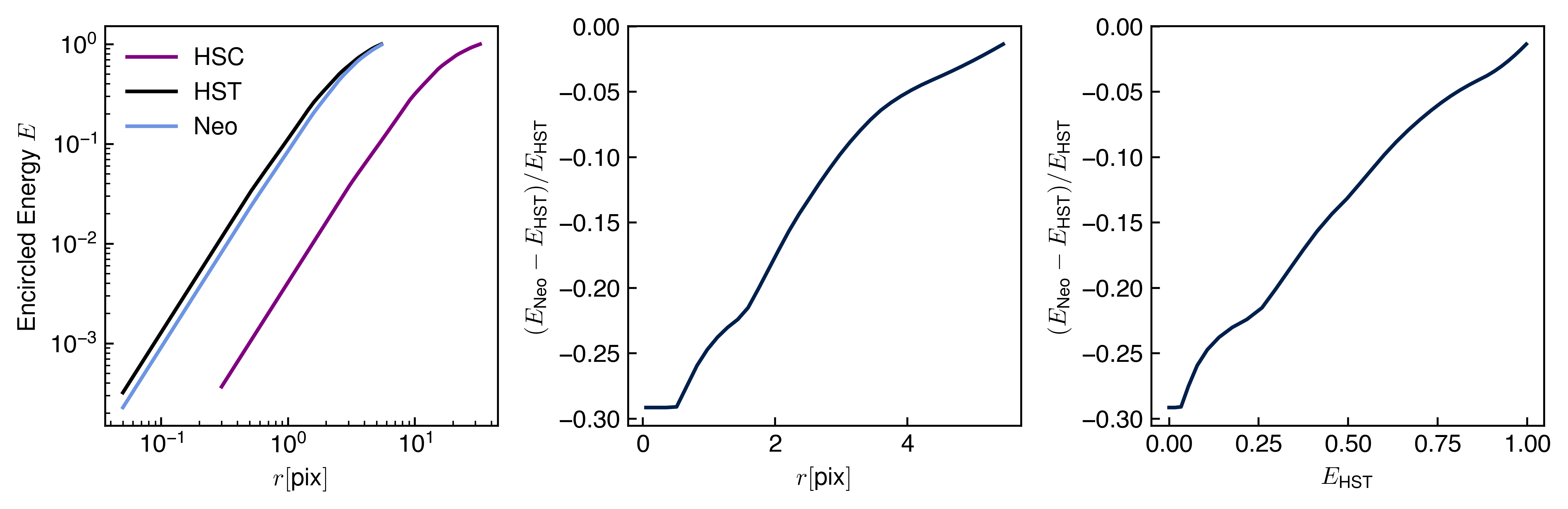
The NEO ePSF closely approximates the structure and size of the HST ePSF, accurately reproducing its central core and even reproducing subtle diffraction spikes.
| B̃Re | B̃FWHM | Bq | B̃C75/25 | S (Orientation) | ||
|---|---|---|---|---|---|---|
| NEO | single | 0.04 ± 0.30 | −0.02 ± 0.06 | 0.03 ± 0.04 | 8.70 ± 0.11 ×10⁻³ | 5.60 ± 0.10 ×10⁻⁴ |
| mosaic | 0.11 ± 0.15 | 0.04 ± 0.05 | 0.03 ± 0.04 | 0.09 ± 0.11 | 1.54 ± 0.06 ×10⁻³ | |
| HSC | single | 0.72 ± 0.18 | 0.82 ± 0.05 | 0.11 ± 0.14 | −0.20 ± 0.11 | 6.6 ± 0.17 ×10⁻³ |
| mosaic | 0.65 ± 0.98 | 0.13 ± 0.24 | 0.11 ± 0.14 | 0.11 ± 0.11 | 0.01 ± 0.18 |
Table: Comparative results for NEO and HSC across key morphological parameters. Bold indicates better performance.
For the set of morphological parameters p ∈ [Re, FWHM, C75/25], we calculate a fractional relative bias between the HSC or NEO measurements and the measurements performed in HST data:
B̃p = ( Mp,X − Mp,HST ) / Mp,HST
For the axis ratio q, we define the absolute bias:
Bp = Mp,X − Mp,HST
For orientation, we use a similarity measure based on the cosine similarity of unit vectors:
S = 1 − |Sc(ûNEO, ûHST)|
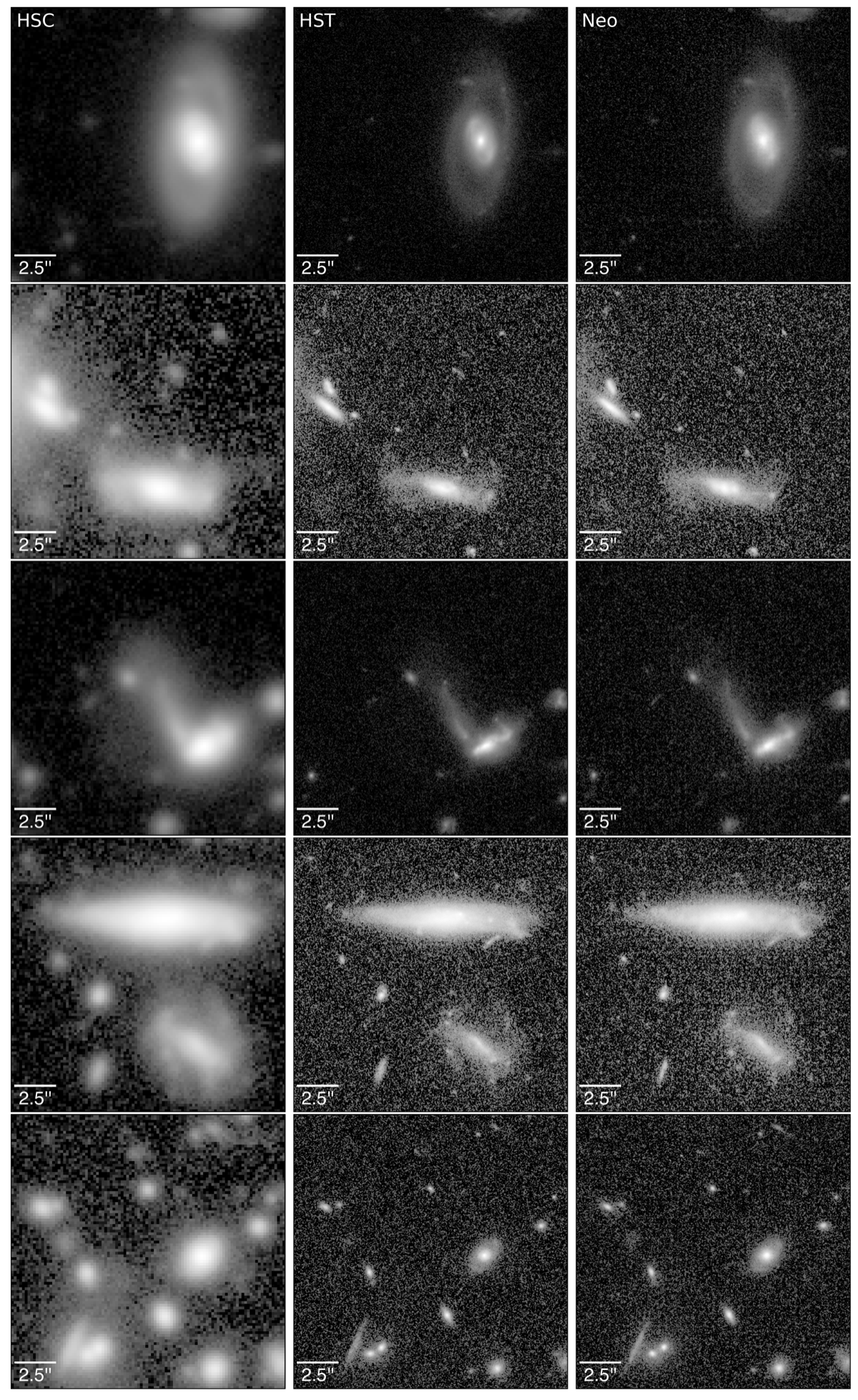
HSC (ground-based input), HST (space-based ground truth), and NEO (super-resolution output) image triplets from the validation set. Fine structures such as merging features, spiral arms, and rings that were hardly visible at the native HSC resolution are present in the super-resolution images.
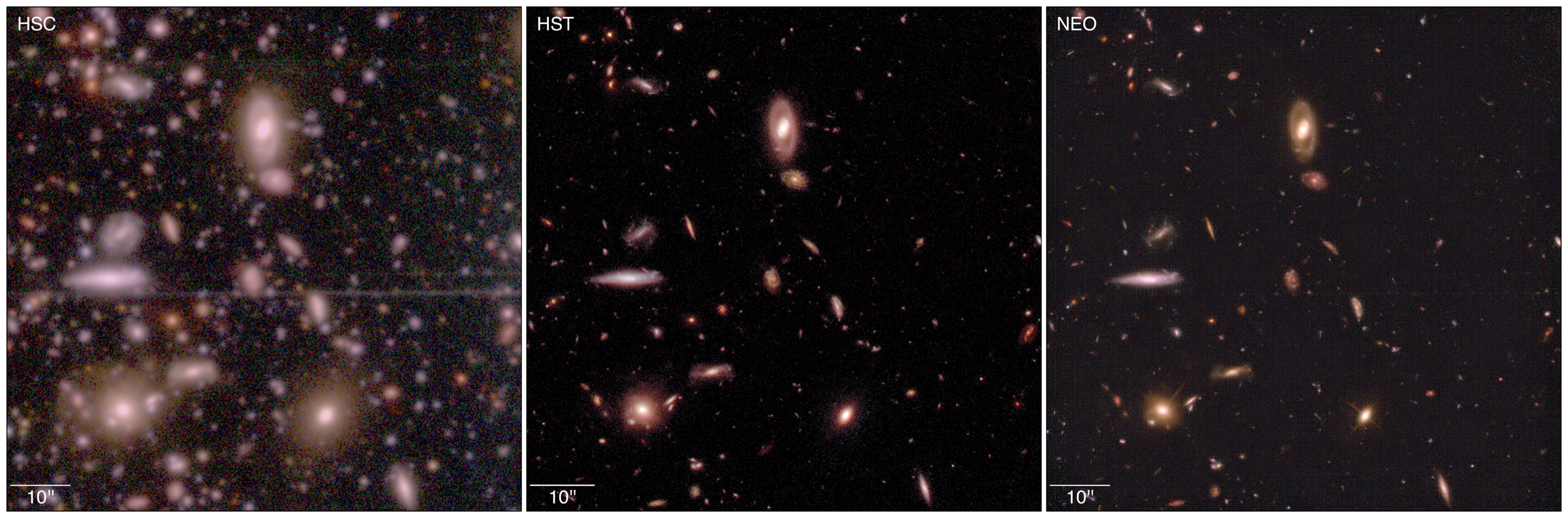
False color images comparing HSC, HST, and NEO. NEO generalizes to multi-band imaging, enabling the production of color images from i, r, and g-band HSC data. The input HSC mosaic is 536 × 536 pixels and the HST and NEO mosaics are 3216 × 3216 pixels.
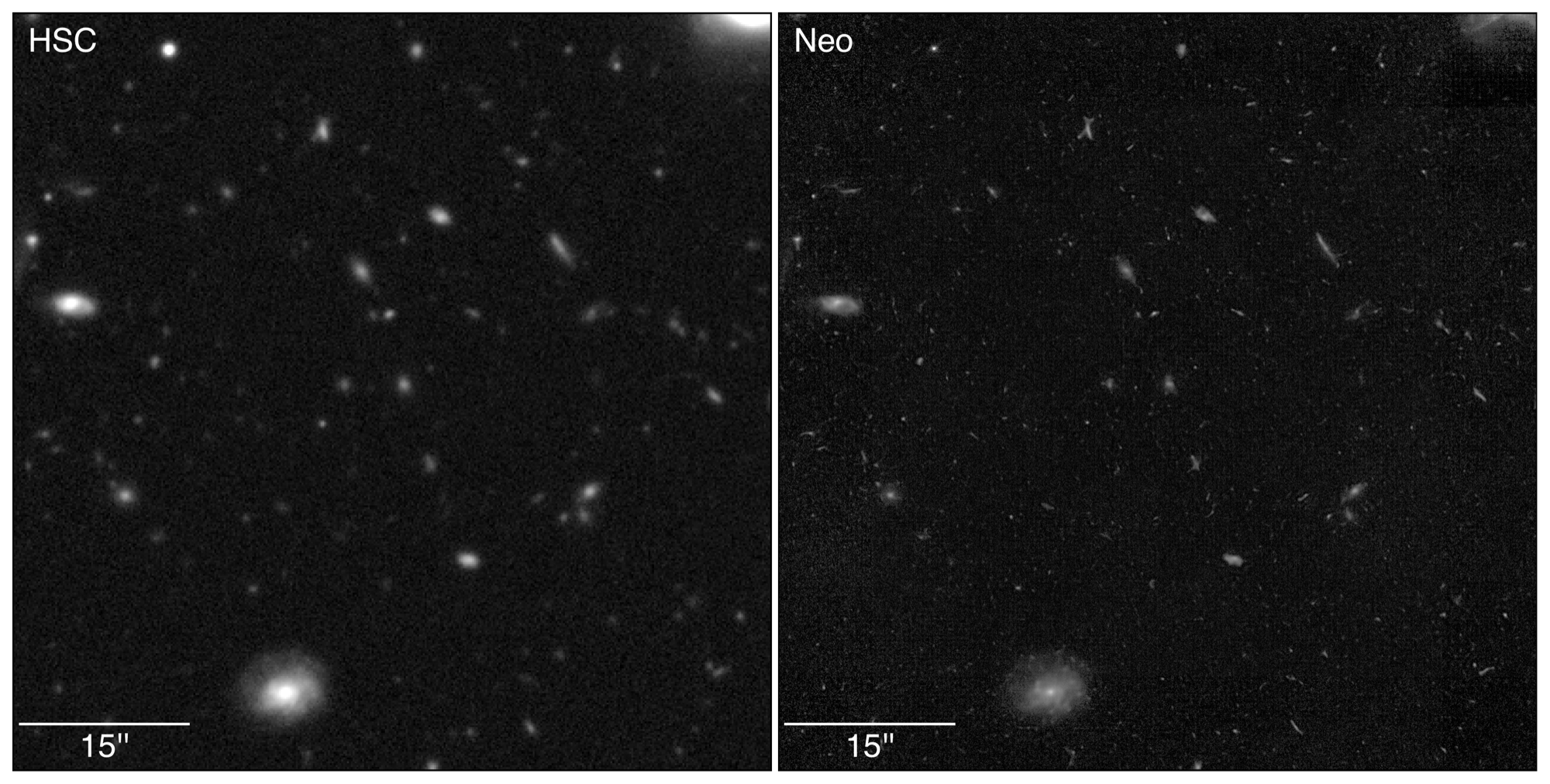
Example of a super-resolved HSC field never seen by HST (DEEP2-3). NEO produces realistic results in a part of the sky never seen during training. The field shown is 15 × 15 arcseconds.
Comparison of galaxy morphological parameters measured for HSC (indigo), HST (purple), and NEO (blue) across galaxy brightness measured in F814W magnitude. NEO closely reconstructs all HST measurements, significantly reducing systematic biases and scatter.
Comparison of the empirical PSFs for HSC, HST, and NEO. The NEO ePSF closely approximates the HST ePSF structure, reproducing its central core and even subtle diffraction spikes.
The encircled energy curve for the ePSF measured from NEO images closely matches that measured for HST images, and is much sharper than the HSC ePSF. The fractional differences between the NEO and HST ePSFs encircled energy are better than 5% by a 4-pixel radius aperture.
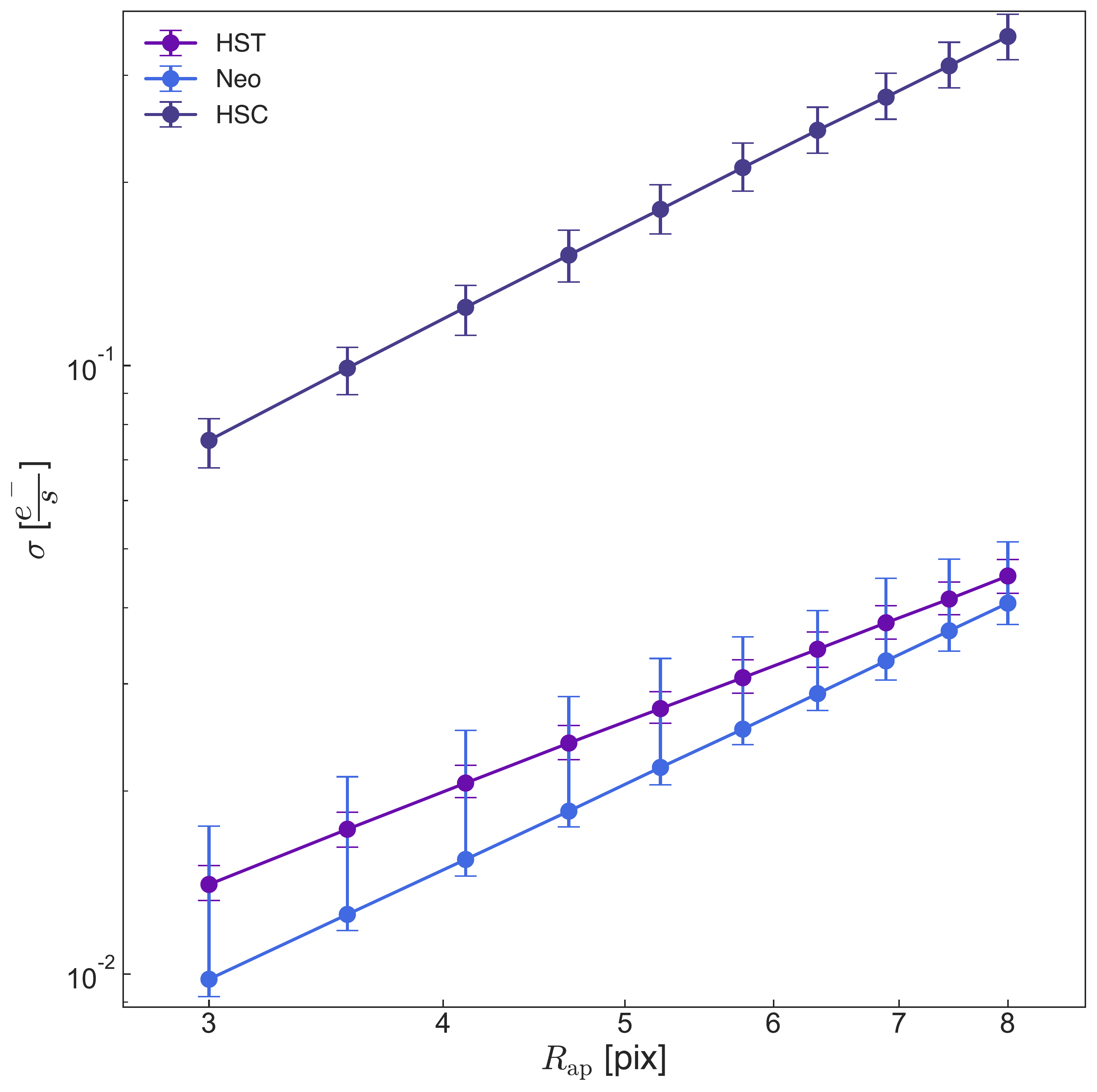
Comparison of the noise properties of HST, NEO, and HSC. NEO recovers the depth of HST, but with increased pixel-level covariance in the noise as quantified by the power-law index.